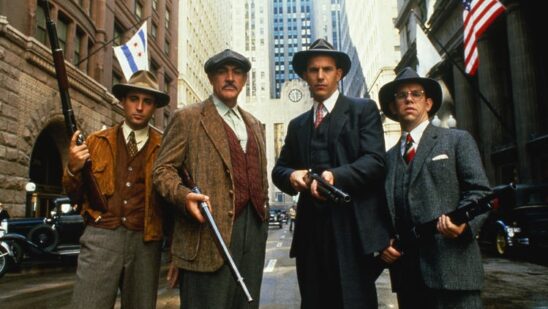
We all see and enjoy movies. So what about gangster movies? Do you enjoy them? Most of them have the same story. So, do all gangster movies follow the same pattern? Well, let’s find out.
Unhappy Endings
Whether it is a gangster film or a television show related to crime, the entire period of the production is spent building up to the endgame, whether that be a shootout, the death of a leading character, or a huge heist, which inevitably goes off without a hitch or goes very badly wrong.
Something that has always intrigued me is why they always go down in deserted warehouses. Unfortunately, we, as general viewers, do not know how criminal gangs in the real world work, but we have to assume that these things are researched and that, in some way, this is reflective of reality.
You will be intrigued to know how this happens. Do the crooks look for industrial units to let or buy for the specific purpose of carrying out criminal activity? Another aspect of this that will always make you laugh is that there is usually a complete lack of anything else going on.
Often, the industrial unit will have an office in it, yet seemingly be otherwise empty. Surely this doesn’t serve much of a purpose, as from what you read about most real-world criminals, they all operate under a front. An empty warehouse is hardly the most subtle place, is it?
Reasons
We wonder if, when people are looking for industrial units to let, they have to state their aims or why they are looking to hire the unit. Presumably, at some point, this would be checked out too, although to be honest, we wouldn’t know for sure. Industrial units are a common theme in crime entertainment, whether in films, television series, or even computer games.
We recall a lot of the action in games such as “Driver” and the “Grand Theft Auto” series taking place in warehouses. Do we wonder if they started life as industrial units to let?
Common Themes
There are, of course, other common themes and stereotypes that run throughout various genres; however, crime is often glamorized by entertainment and made to look extremely lucrative, with a great deal of time seemingly spent in abandoned industrial units. Give me a warm office with an espresso machine every day of the week, but each to their own.
Presumably, your reason for seeking out industrial units to let has nothing to do with any criminal desires. Whatever the reason, whether it be for storage or to use as a base for your business, industrial units for let can serve many great purposes.
Why the Warehouse Keeps Showing Up
A warehouse makes a convenient film location, since a director can make it seem cut off from everyday life. It offers wide floors, high ceilings, and long rows of shadows. A few work lights can transform an empty room into a spot where a deal might go wrong. Add a metal door and a parked van, and the audience senses the scene is serious before anyone speaks.
It also gives a production room to move. A crowded restaurant or busy street brings noise, extras, and countless details that can pull focus from the scene. A bare industrial space lets the camera see the people in it clearly. The director can place them far apart, then let each footstep travel across the room. In a film, even an empty corner can feel threatening.
There is a practical reason as well. One location can serve as many places: a meeting spot, a hideout, a storage room, or the site of a final confrontation. The film need not explain who owns the building or why the gang can access it. We accept the setting and move on. Real life demands paperwork. Movies demand a good shadow.
A Shortcut the Audience Understands
Gangster stories rely on visual shorthand. A dark car, a quiet table, a warehouse door—these signal that someone has entered dangerous territory. The setting need not be realistic in every detail. It just has to establish the mood. That’s why the warehouse feels so familiar: it quickly signals that normal rules stay outside.
It can also make a character seem powerful. A boss alone in a vast room appears to own it, even if the set is just a rented space dressed for the scene. The scale flatters him. Then a small sound, a sudden arrival, or a bad choice can make that same space feel terrifyingly exposed. The room shifts with the character’s luck.
Of course, the trick wears thin when every criminal meeting happens beside a stack of boxes. A little variety helps. A family kitchen can show how crime has seeped into private life. A bright shop or a crowded street can make danger feel uncomfortably near. The best setting usually says something about the people in the story, rather than just looking suitably grim.
Do Gangster Films All Tell the Same Story?
Many do share a familiar shape. Someone wants money, respect, or control. A small win raises the stakes, loyalties are tested, and one mistake begins the fall. The pattern works because it gives the audience a clear rise and a clear cost. You can often guess where the story is going, yet still want to see which choice gets the character there.
But the genre holds more than one kind of story. Some films follow a person who enters the criminal world and slowly loses the life they once had. Others start with a family or crew already in power and watch it strain under greed, age, or distrust. A heist story can focus on planning and timing. A police drama may dwell more on pressure and investigation. The same broad subject can yield very different films.
The ending changes the meaning, too. A gangster who dies after years of success warns us about the price of that life. A character who survives but loses everyone close may have a more bitter fate. Sometimes the crew gets away with the money, yet the story still feels bleak because nobody can trust anyone. A body count is not the only way to make an ending unhappy.
The Glamour Has a Cost
Crime films make the clothes, cars, and swagger look tempting. The music turns a walk into a victory lap, and the gang seems to have money for everything. That style is part of the fun. It can also make life look cleaner than it is, especially when a film dwells on the rewards and not the people hurt along the way.
The stories that stick with you tend to show both sides. Loyalty can mean standing by a friend, but also being trapped by a promise you never should have made. Respect sounds appealing until everyone around you is afraid to speak honestly. Even success becomes a burden when the character must guard it every minute. The suit is sharp; the life inside it is not.
That tension is why audiences keep coming back to the genre. We can enjoy the style while knowing the characters are making choices with ugly consequences. A good gangster film does not need to lecture. It can simply let a boastful character sit alone after the party, or show how fast a confident plan falls apart when trust runs out.
More Than One Kind of Crime Story
Humor has a place here as well. In some crime stories, characters are vain, petty, or utterly inept at the work they claim to grasp. A tense meeting can become absurd when no one can agree on the smallest detail. Such moments don’t erase the danger. They make people seem more human, and at times more foolish.
Films also shift focus based on whose perspective we take. A tale told from within a crew can make its rules feel normal for a while. Told through a family member or an investigator, the same behavior looks alarming right away. Neither viewpoint must explain everything. A change in perspective can achieve more than another warehouse standoff.
That leaves ample room for new choices. A gangster film can keep the familiar rise-and-fall arc yet still surprise us through its setting, tone, or central figure. The warehouse may still serve a purpose, but it need not be the entire story. After all, a criminal empire can crumble in a quiet office just as easily as in an empty factory.
So the warehouse is less a map of real criminal life than a dependable piece of movie vocabulary. It offers filmmakers space, shadows, and a quick way to signal that trouble is coming. Gangster films share a few beats, but the memorable ones give those beats distinct people and a distinct cost. Which setting makes a crime scene feel most convincing to you?
