
Many ancient Roman buildings have survived to this day. The following list includes 15 famous ancient Roman buildings that still stand as a tribute to Roman ingenuity.
15. The Temple of Augustus
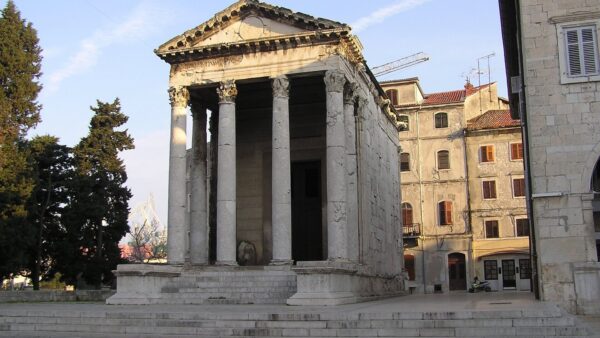
In Pula, Croatia, the Temple of Augustus stands on the site of the old forum. Erected between 2 B.C. and 14 A.D., it was dedicated to Augustus and to Roma, the goddess of Rome. Its lofty porch and intricately carved columns are still visible today.
Through the centuries, the temple was used as a church and then a storehouse, before it became a museum. During the Second World War, a bomb caused severe damage, and it was later rebuilt. That reconstruction work greatly shaped the form it has today. Today it displays ancient sculptures in stone and bronze.
14. The Temple of Portunus
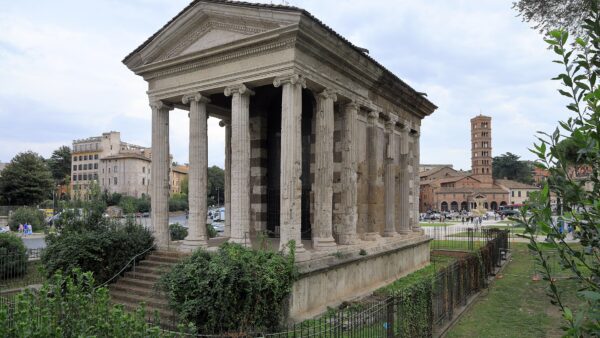
Image Courtesy: Torquatus / Wikimedia Commons
Portunus was the deity of harbors, and that explains why this temple stands close to Rome’s ancient river port. The structure before you was built around 80 to 70 B.C., taking the place of an earlier shrine. With its elevated base and four columns across the front, it still clearly resembles a Roman temple.
If you scan the sides, you’ll notice that the majority of the columns are built into the walls. Even where they aren’t freestanding, they remain part of the design.
During the Middle Ages, the temple was turned into a church, which helped keep its outer shell intact. Inside, a few of the Christian wall paintings added later remain.
13. The Theatre of Marcellus
Fiat 500e via Wikimedia Commons
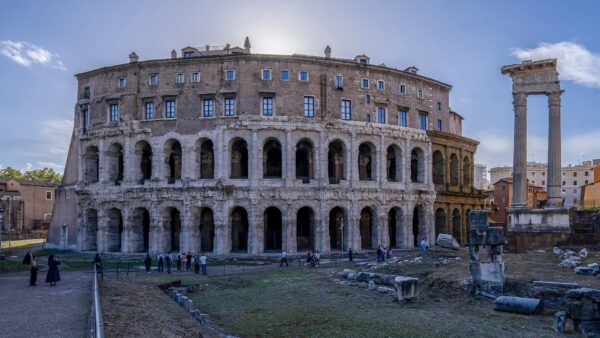
If you view the Theatre of Marcellus from the street, its rows of arches could easily be taken for a section of the Colosseum. This theatre predates it. Julius Caesar started the work, and Augustus completed it toward the close of the first century B.C., naming it after his nephew Marcellus, who had died young.
Its curving stone shell once contained rows of seats arranged to face a stage. Owners in later times converted the structure into a fortress. During the 1500s, a palace rose atop the Roman arches, and that blend of residences and ancient masonry continues to shape the site today.
12. The Basilica of Constantine
Markus Bydolek via Wikimedia Commons
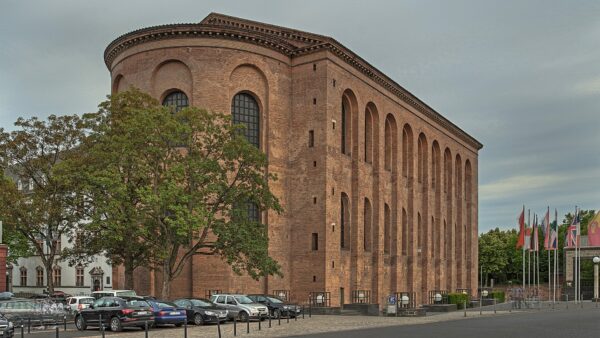
The Basilica of Constantine, located in Trier, Germany, was originally constructed as an audience hall for an emperor. Erected around 310 A.D., it provided Constantine with an enormous space in which to receive visitors and handle court affairs.
The main hall is free of any colonnade that might divide it. Because of that unbroken expanse, the soaring brick walls appear even taller. Inside, the Roman-era space once featured marble wall panels and a heated floor—clear evidence that comfort was valued even in a room designed to impress.
Today the structure functions as a Protestant church. It was badly damaged during the Second World War and later restored, which means the bare interior visible now is not the same as the emperor’s lavishly adorned hall.
11. The Porta Nigra
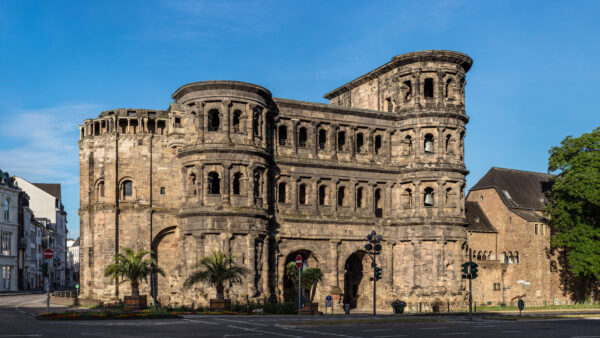
Thomas Wolf, www.foto-tw.de via Wikimedia Commons
Black Gate suits the Porta Nigra in Trier, Germany, quite well, even though its sandstone was not always so dark. The color came from years of aging and exposure to the weather. Construction started around 170 A.D., at which time the gate was part of the Roman city’s defensive system.
It was inhabited by a monk named Simeon in the eleventh century, and the gate was subsequently converted into a church. It was spared from being disassembled for its construction stone because of this new use. Napoleon ordered the removal of the majority of the church modifications in the early 1800s, displaying a large portion of the Roman gate once again.
10. The Aqueduct of Segovia
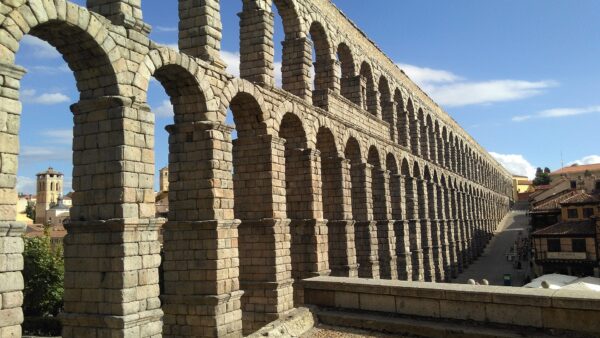
G41rn8 via Wikimedia Commons
To construct the Aqueduct of Segovia in Spain, the Romans piled up massive granite blocks without any mortar between them. The way the stones fit together and how the arches distribute their weight both help the structure remain standing. At its tallest point, it stands roughly 28 meters above the ground.
Along its path into the city, the arches supported a channel that carried water over low-lying terrain. Gravity alone brought the water to public fountains and storage tanks. Generally dated to the early second century A.D., the aqueduct served the city for many centuries. Over its long existence, sections of the structure have been repaired and rebuilt.
9. The Temple of Bacchus
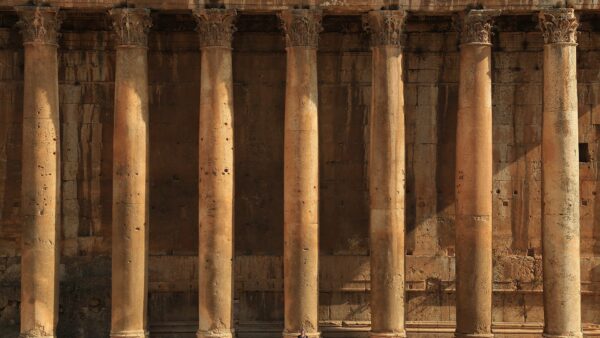
Alexandre Mounayer via Wikimedia Commons
Among the large Roman temples, the Temple of Bacchus at Baalbek in Lebanon ranks as one of the most intact. A large part of it goes back to the second century A.D. Tall columns remain standing around most of the main hall, and the enormous entrance still preserves a great deal of carved stone detail.
The temple’s name links it to the deity of wine, Bacchus. Though the building’s exact dedication is not firmly established, grapes and scenes connected to his cult show up in its ornamentation. Large sections of the walls still loom over the site, but the roof is no longer there. From the surviving structure, you can make out the inner hall and the deep porch.
8. The Mausoleum of Hadrian
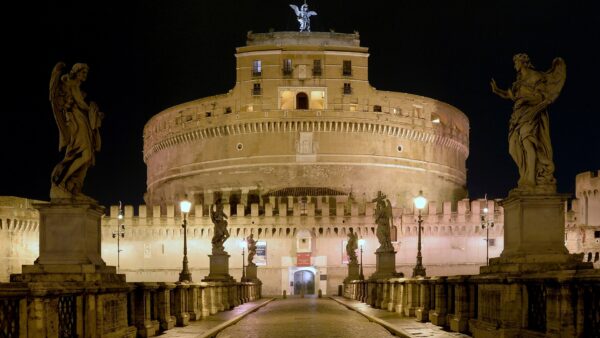
Livioandronico2013 via Wikimedia Commons
Castel Sant’Angelo resembles a fortress for the reason that it served as one for many centuries. The Roman structure at its center was originally built for an entirely different function. In the second century A.D., Hadrian commissioned it as a tomb for himself and his family; it was finished in 139 A.D., following his death.
Within the later castle, the mausoleum’s massive round form still stands intact. A wide spiral ramp inside once ascended toward the burial chamber. The building eventually became part of Rome’s fortifications and was used as both a jail and a haven for the pope.
A great deal of what you see above and around that core dates from later centuries. The painted papal chambers and the angel atop the roof were added long after the era of the Roman emperors.
7. The Maison Carrée
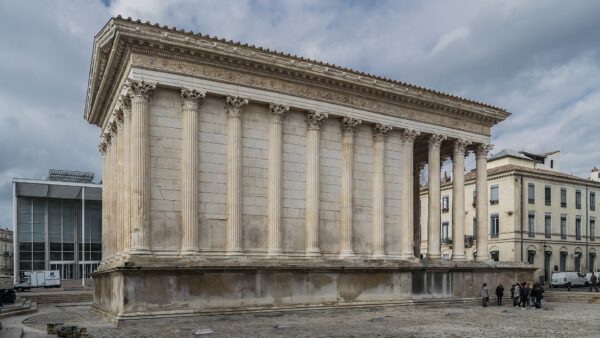
Krzysztof Golik via Wikimedia Commons
There is more to Nîmes, France, than its arena. The Maison Carrée is a Roman temple built in the early first century A.D. and dedicated to Gaius and Lucius Caesar, the grandsons and adopted heirs of Augustus. Neither of them lived long enough to succeed him.
Six columns stand at the front, facing the square from a tall porch. Further columns line the sides, most of them attached to the walls. The carved leaves at the tops are still visible, as are the temple’s raised base and wide flight of steps.
Its purpose shifted over the centuries, and it remained in use, at times as a private home and at others as a church. Those new functions helped keep the building standing. In 2023, it was designated a UNESCO World Heritage Site.
6. The Pont du Gard

The Roman aqueduct system that delivered clean water from mountaintop springs into cities for use by the public was one feat of engineering that set Rome apart from other ancient civilizations. A few sections of the ancient aqueduct exist in the city of Rome, but the most spectacular surviving examples are in France and Spain.
The Pont du Gard, a section of the aqueduct with three layers of columns and arches, is a popular landmark and tourist attraction in southern France. The Pont du Gard was constructed of local limestone blocks around the middle of the first century A.D. and was used to transport water to the city of Nîmes.
5. The Pons Fabricius

The oldest complete bridge still standing in Rome, the Pons Fabricius, was constructed across the Tiber in 62 B.C. The structure is built from concrete and volcanic stone with travertine facing and later brick repairs. It has two large arches that span the river, with a smaller flood relief arch in the central pier.
The stone bridge replaced an older wooden bridge and is still used for foot traffic today.
4. The Amphitheater at Nîmes

Constructed in the style of the Colosseum, the smaller amphitheater in the Roman city of Colonia Nemausus, now Nîmes, France, was built around the same time as its larger Roman counterpart and was used similarly to hold public games and festivals.
The structure fell into disuse, and homes were constructed inside it during medieval times. In the 1800s, it was cleared and restored for use as a bullfighting arena, and it is still used for bullfights and concerts to this day.
3. The Pantheon

The Pantheon has the world’s largest unreinforced concrete dome. The concrete dome of the Pantheon is around 140 feet high at the center and is about the same distance across at the base.
The concrete gets thinner at the top, and lightweight volcanic rock is used as aggregate to decrease the weight. The coffered ceiling also reduces weight. The building has been a Christian church since 609 A.D. and is the burial place of Italian royalty and public figures.
2. The Colosseum

No list of impressive ancient Roman buildings would be complete without the Colosseum, commissioned by Emperor Vespasian around 70 A.D. and opened by his son Titus in 80 A.D. As impressive as it is today, much of the Colosseum’s exterior façade was looted for use in later construction projects, including St. Peter’s Basilica.
With wide, evenly spaced piers spanned by arches that spread the weight of the building while allowing easy access for up to 50,000 spectators, the Colosseum is the model for today’s modern sports stadiums.
1. The Cloaca Maxima

The exact age of the Cloaca Maxima, Rome’s great sewer system, is hard to pinpoint. Some parts are estimated to be over 2600 years old. Originally designed to drain the low ground around the future Roman Forum into the Tiber River, it was later expanded to carry wastewater from public baths and lavatories as well as stormwater.
Some portions of the Cloaca Maxima are still in use, much as in ancient times, as part of Rome’s stormwater collection system.
Other Notable Ancient Roman Buildings
- The Pula Arena
- The Roman Theatre of Orange
- The Roman Forum
Did you like our list of the top ancient Roman buildings that still stand? Let us know your thoughts in the comments below!
Tiberius Bridge in Rimini, Italy. Amazing!