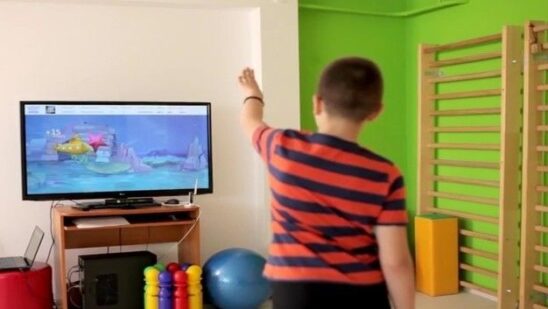
PC and video games for physical therapy rehabilitation can give exercise a clear goal and make repeated movements less dull. Physical therapist assistants help patients follow a treatment plan under a physical therapist’s direction. That plan may include games chosen for a specific movement or task. Here we take a look at games and interactive devices used for rehabilitation, along with consumer titles a therapist may consider for supervised practice.
Some entries support speech, coping, or health education within a broader care plan. Their roles are explained where they appear. Some older titles remain usable on their original hardware; research projects and games with uncertain access are marked as such.
LusioMATE
LusioMATE turns prescribed movements into game controls through small wearable sensors. A therapist sets the movement goal, and you use that movement to play. It supports practice for people with cerebral palsy and other conditions, with settings based on what the person can do.
GameWheels
An interactive research system tested with patients with spinal cord injuries. It allows wheelchair users to become physically active through game interactivity. The wheelchair sits on rollers, and turning its wheels controls a computer game.
GameWheels is documented in older research. Current commercial availability couldn’t be verified, so this entry serves as a historical example.
Myndlift
Myndlift uses a compatible EEG headband and an app to provide feedback while you play games or watch content. A practitioner can set the training plan. This is an option for guided neurofeedback, with a different role from movement exercises in physical therapy.
Cooking Mama
This is a variety of mini-games that are timed. In the Nintendo DS version, you use a stylus to chop, stir, and prepare food. Those actions give a therapist tasks to consider for hand practice, but a timer alone doesn’t prove that a game improves motor skills.
The original DS game remains an option for someone who has a working console and game card.
Flash Focus
Flash Focus uses short visual tasks and sports games on Nintendo DS. You track objects and respond with the stylus. Its full title is Flash Focus: Vision Training in Minutes a Day.
A working DS and game card let you use the original game. Treat it as a set of visual challenges; the title isn’t proof that it treats an eye condition.
SuperBetter
SuperBetter uses game ideas to turn personal goals into small challenges. You can play on your own or join group challenges. Its focus is coping and resilience, with tasks you can use to work towards a personal goal.
Lumosity
Lumosity still offers games built around memory, attention, and problem-solving. You can track your game scores as you practise.
Better game scores don’t establish recovery from a stroke or brain injury. In 2016, Lumosity settled FTC charges over unsupported claims about real-life and health benefits.
XRHealth
XRHealth offers VR care with exercises presented as interactive tasks. A clinician chooses the programme and tracks your performance. Access depends on the service and country.
emWave Biofeedback Games
HeartMath’s emWave software includes Balloon, Garden, and Rainbow games. A sensor measures heart rhythm, and the games respond to the software’s coherence score. They give you feedback while you practise the breathing and self-regulation methods taught with the system.
Re-Mission
Re-Mission teaches teens and young adults about cancer treatment through a game in which a tiny robot fights cancer cells inside the body.
A published trial found gains in treatment adherence and cancer knowledge. It didn’t find a reduction in reported stress, and it didn’t establish a benefit for hand-eye coordination. This is a legacy education game; Hopelab now presents it as part of its history, and a current official download couldn’t be verified.
The Journey to Wild Divine
This is an adventure game that helps patients learn to breathe and meditate. The original game used biofeedback sensors, so the hardware and software have to match.
Wild Divine still offers interactive meditation with its iom2 device, including events drawn from the original Passage programme. That doesn’t make every old copy compatible with today’s equipment.
MyPlate Match Game
In this browser game, children drag foods into groups and build a plate. It’s a clear way to talk about food with a child. It covers nutrition education and can be used for that purpose alongside a wider care plan.
Speech Therapy Games
There are several games available that help children practise speech sounds. Articulation Station Hive is one current example, with structured practice and activities created by speech-language pathologists.
These belong in a speech plan. A speech therapist can choose the sounds and level of practice that fit the child.
A specialist like CK PHYSIO can assess your movement and plan physical treatment around your needs. In rehabilitation, game choices should follow the goals set by the therapist.
Zwift
Zwift turns pedalling on compatible cycling equipment into movement through a virtual world. It offers routes and group rides, so a short ride can have a goal beyond watching the clock.
For rehabilitation, a therapist needs to set the workload. A race that makes you push harder isn’t always the right session.
Bodypad
Bodypad is a legacy motion controller for consoles including PlayStation 2 and the original Xbox. Body movements trigger controls in compatible games, making play more physical.
It isn’t a current PC rehabilitation service. Its place here is for readers who already have the older equipment; compatibility has to be checked for the console and game.
EyeToy
Another interactive device with a variety of games that promotes physical activity.
The EyeToy is a PlayStation 2 camera used with games such as EyeToy: Play and EyeToy: Kinetic. A working camera, console, and compatible disc can still provide offline motion play. It needs enough space and lighting for the camera to track you.
Ring Fit Adventure
A squeeze of the Ring-Con can move the action forward. Ring Fit Adventure uses that flexible ring and a leg strap to turn exercise into battles and travel on Nintendo Switch.
Custom routines let you choose exercises instead of following the whole adventure. If you use a Switch 2, you’ll still need the original Switch Joy-Con for the Ring-Con; Joy-Con 2 won’t attach to it.
Nintendo Switch Sports
Bowling gives you a clear target and a repeatable arm action. Other sports ask for quite different movements, so the choice of sport matters. Nintendo Switch Sports uses Joy-Con motion controls, with a leg strap for some soccer play.
Wii Sports
Wii Sports is still worth considering if you already own the hardware. Bowling uses an arm swing to roll the ball, while tennis asks you to time a stroke.
Those are game actions a therapist can assess for a session. The Wii Remote can also register a small flick of the wrist, so a high score alone won’t tell you whether you practised the intended movement.
Wii Fit Plus
The Wii Balance Board measures how your weight is distributed while you use Wii Fit Plus. Its balance games put a visible goal on screen, which can make shifting weight less abstract.
This needs a compatible Wii setup and the board. Anyone who needs help standing should have that support arranged before stepping onto it.
Fitness Boxing 3: Your Personal Trainer
One useful feature here is Sit Fit Boxing. It provides seated routines, with choices of duration and difficulty, on Nintendo Switch.
You follow cues and punch in time with the music. That gives a therapist an option to assess when standing exercise is unsuitable, provided the arm movements fit your plan.
Just Dance
Follow the dancer on screen and move to the song. Just Dance turns a routine into something you can share with another player. Editions such as Just Dance 2026 are available on Switch, PlayStation 5, and Xbox Series consoles, with controls that depend on the platform.
For a therapy session, the routine needs to fit the movement goal. Finishing the song isn’t the only thing to judge.
DanceDanceRevolution
The arrows tell you where and when to step. DanceDanceRevolution uses a dance platform or compatible mat to turn foot placement into a rhythm challenge. It’s a game to discuss for stepping practice only when standing balance and the pace of play fit the patient.
Beat Saber
Beat Saber asks you to slice blocks in set directions to the beat. On a suitable difficulty, that gives a therapist a task to assess for arm movement and timing.
Keep the required movement within your prescribed range. Faster songs and wider swings change the demands of the session; they don’t make it better therapy.
Synth Riders
In Synth Riders, you move your hands to meet coloured notes and follow rails through the air. The flowing movements feel different from chopping blocks. It’s a consumer VR game that may offer a useful movement task when a therapist chooses suitable settings.
Audio Trip
Audio Trip gives your hands a path to follow, with gems to catch and ribbons to trace. Barriers also ask you to move out of the way. The game includes a Cardio mode, but a rehabilitation session may call for a much smaller dose of movement.
OhShape
Here, moving into the right pose lets you pass through a shape in a wall. You also dodge or punch other walls to the music. OhShape asks for whole-body movement, so its poses need checking against the person’s balance and joint limits.
Racket: Nx
Racket: Nx puts you inside a dome where racket hits send a ball towards targets. The action can include quick turns as well as arm swings. A therapist may find a use for the aiming task, but the turning demands make this a poor fit for some patients.
Eleven Table Tennis
You can practise against the computer or use training activities in this VR table tennis game. The paddle gives you a clear task: meet the ball with a controlled stroke.
For rehabilitation, the speed and reach of that task need to suit the session. Trying to save every shot can pull you well outside your intended range.
Walkabout Mini Golf
Walkabout Mini Golf lets you line up a putt and choose when to take it. That slower pace may suit a therapist’s plan better than a game that keeps sending targets at you. It uses a virtual club and offers solo play as well as rounds with others.
LES MILLS BODYCOMBAT
This VR fitness programme puts coached combat movements into a game setting. You strike targets and follow the workout. It belongs at the exercise end of this list, where the pace and movement load need careful selection for someone in rehabilitation.
FitXR
FitXR offers several styles of VR exercise, including boxing and dance. Its different classes let you choose the kind of movement you want to do.
That choice is useful, but class labels don’t set a safe rehabilitation workload. Your therapist still needs to decide which movements and session length fit.
Nex Playground
Nex Playground uses a camera to turn body movements into game controls. There’s no handheld controller to grip. Its family games make it an option to assess when holding a controller is a barrier, though camera play still needs enough space and suitable movements.
Kinect Sports
The original Kinect Sports tracks your body for activities such as bowling and table tennis. It needs an Xbox 360 and its Kinect sensor.
Existing compatible equipment can provide motion play without a controller. Check the space and sensor setup first; Kinect hardware from a different Xbox generation isn’t a drop-in substitute.
MindMotion GO
MindMotion GO uses motion tracking and game tasks for adults with neurological conditions. Therapists set the exercises and can review the training. Some programmes provide it for home use, including the programme described by Mount Sinai.
It requires specialist motion tracking equipment and the rehabilitation software.
MusicGlove
Touch your thumb to a finger in time with the notes. MusicGlove uses those contacts to control a music game, turning repeated hand movements into a song.
It has been studied for hand rehabilitation after stroke, but it needs some active thumb and finger movement. The evidence doesn’t justify a promise that it will work for every level of impairment.
FitMi
FitMi uses two sensor pucks with exercise software. Depending on the task, you move or squeeze them and receive feedback on your repetitions. It covers exercises for more than the hand, so a therapist can choose activities that fit the body area being treated.
NEOFECT Smart Glove
Sensors record movements of the fingers, wrist, and forearm while you use the Smart Glove’s training activities. Games give those movements a visible goal. The system is designed for upper limb rehabilitation, with exercises chosen around the user’s ability.
Able Rehab with GripAble
GripAble’s current rehabilitation platform is presented as Able Rehab. The handheld sensor measures grip and release as well as wrist movements. Games can be set to the person’s level, so a small movement can still control an activity.
For example, Pufferfish targets wrist flexion. The movement being practised is clearer than it would be in a game with a standard controller.
ReJoyce
ReJoyce uses a physical device to control computer games with hand and arm actions. Tasks resemble actions from daily life, such as pouring a drink or opening a jar. The manufacturer specifies clinician supervision, so this is an option to ask a rehabilitation service about.
Tyromotion PABLO
PABLO combines movement sensors with interactive exercises. Its grip sensor measures grasp and release, while other parts of the system let a therapist track movements of different body areas. That gives the game feedback about the action the therapist wants you to practise.
Tyromotion TYMO
TYMO is a force plate used with therapy software and feedback on screen. Weight shifts can become part of an interactive task.
It can be used in seated positions as well as standing, among other setups. That’s a useful detail when full standing practice isn’t yet appropriate.
Rehametrics
Rehametrics offers separate physical, cognitive, and occupational rehabilitation modules. Its movement exercises use game tasks, with settings and reports for clinicians. A centre can choose the modules that fit its patients.
Jintronix
A ski activity is one example of the games used in Jintronix. The platform also covers goals such as balance and range of motion, and gives therapists measures to review. It’s designed for rehabilitation programmes, where the chosen game serves a treatment goal.
Khymeia VRRS
The Virtual Reality Rehabilitation System brings several therapy modules together with sensors and interactive exercises. A clinic can use it for motor work or other parts of rehabilitation, depending on the setup. The equipment and chosen module determine how you interact with the task.
REHABILITY
REHABILITY was developed with patients and clinicians. It offers physical and cognitive games, with a therapy plan set by the professional and progress that can be checked remotely. That home practice link is useful when a session at the clinic needs to be followed by regular work between visits.
Bimeo
Bimeo provides game tasks for arm movement, including modes that use both arms together. Some setups support the arms on a pad; others work in free space. A therapist chooses the mode and movement range, so the same system can be used for different stages of practice.
CUREO
CUREO puts motor and cognitive exercises inside a VR headset. Its modules include hand work and tasks based on daily activities. Clinicians can adjust the exercises as part of a treatment plan, which makes it a purpose-built therapy system.
Hocoma ArmeoSpring
ArmeoSpring supports the weight of the arm while the patient uses game tasks on a screen. That support gives a therapist a way to work on active movement when lifting the arm against gravity is difficult. The support and exercises are set to the patient’s needs.
Hocoma Lokomat
Lokomat pairs robotic gait training with feedback in virtual environments. Some tasks involve following a path or avoiding obstacles, which gives the walking session an on-screen goal.
The game is one part of a specialist walking system. Staff set the support and training demands.
C-Mill
C-Mill projects targets and obstacles onto a treadmill and can also use virtual scenes on a screen. Those cues let a patient practise changing a step to match what lies ahead. A clinician controls the treadmill and tasks, with the safety setup suited to the patient.
SilverFit 3D
SilverFit 3D uses a camera and games for movement practice, particularly in care for older adults. Activities can be adjusted to the person’s abilities. Its game settings give staff a way to choose the movement task, rather than asking everyone to keep up with one standard routine.
SilverFit 3D uses a camera and games for movement practice, particularly in care for older adults. Activities can be adjusted to the person’s abilities. Ski Slalom is one of its game activities.
Dividat Senso
Step onto the platform and respond to cues on the screen. Dividat Senso combines movement with tasks that ask you to react or make choices. It offers games and assessments for use in care settings, so thinking and stepping can be practised in the same session.
Tovertafel
Tovertafel projects games onto a surface and responds to hand movements. In Windmills, for instance, moving a hand over the image starts it spinning.
The system is designed for people with cognitive challenges, including dementia. It can bring movement into shared play, with the activity chosen to fit the person.
Constant Therapy
Constant Therapy offers structured exercises for speech, language, and cognitive skills, with feedback on the practice tasks. For someone in a broader rehabilitation programme, it may provide work to discuss with the speech or cognitive care team.
Tactus Language Therapy
Language Therapy combines exercises for speaking, listening, reading, and writing at word level. It’s available on iOS and Android and was designed for people with aphasia. A speech therapist can use its tasks to support a language plan.
RehaCom
RehaCom provides computer exercises for cognitive rehabilitation, including attention and memory work. Its home training option can follow a plan from a therapist. The tasks are chosen around the person’s cognitive goals.
NeuronUP
NeuronUP includes games that a professional can adjust for cognitive practice. One example asks you to place moving numbers in order, giving attention and memory a task to work on. The clinician can choose an activity and change its level as part of the programme.
HappyNeuron Pro
HappyNeuron Pro gives clinicians a collection of cognitive exercises and a way to assign home practice. That makes it an option for a care team looking for structured tasks between appointments. Its role here is cognitive work, which needs its own goals and progress checks.
BrainHQ
BrainHQ offers exercises including Memory Grid and Target Tracker. Each exercise provides specific activities to practise, along with its own instructions. When the goal is rehabilitation following an injury, a professional should select the task; evidence concerning one exercise does not demonstrate that every game addresses the same problem.
MindPod Dolphin
MindPod Dolphin uses an ocean setting for motor and cognitive training. The dolphin gives the activity a focus that feels less like a standard drill. It’s part of a specialist system used for therapy programmes, with the exercises and dose chosen around the patient.
PLAYBALL
PLAYBALL adds sensors to a therapy ball and links it to interactive exercises. Movements with the ball control the activity and give feedback. The system offers a way to build gameplay around a physical object already used in therapy, including hand practice.
SilverFit Flow
A digital spirometer links your breathing to games in SilverFit Flow. The display gives you cues and feedback for exercises such as controlled exhaling. This is a breathing therapy tool with tasks set by a professional, which gives it a different role from a meditation game.
MOTOmax on MOTOmed
On the MOTOmed gracile12, active arm or leg movement makes the MOTOmax character jump and collect points. Equal effort from both sides is reflected in the game. It’s built into compatible movement therapy equipment, so a therapist chooses the machine and setup.
SilverFit Mile
SilverFit Mile connects a stationary bike to filmed routes through a wireless sensor. As you pedal, the view moves along the route. For a person who prefers scenery to racing, this gives indoor cycling a point of interest while staff set the exercise workload.
SilverFit Alois
SilverFit Alois combines touchscreen games with activities such as seated dancing and music conducting. It is designed for dementia care. Staff can also use personal photos in activities, which gives a family member a way to join in.
Equio
Equio uses a sensor platform for balance exercises with feedback and games. It offers a stable surface mode as well as a tilting mode. This allows the therapist to choose a challenge suited to the person’s current balance.
Mightier
Mightier pairs children’s games with a heart rate sensor. An on-screen meter shows changes in heart rate, and children practise calming skills before returning to play.
The activities focus on emotional regulation. For a child whose care includes work on calming skills, this gives that practice a place inside play.
Forza Horizon 5
Forza Horizon 5 offers driving assists that can reduce the inputs needed to drive, including assisted or automatic steering. That lets the player keep control of some actions while the game handles others.
It may be an option for a therapist to assess for controlled input practice. The assists need to leave the intended action with the player; a car completing a lap doesn’t prove that a movement goal was met.
Xbox Adaptive Controller
The Xbox Adaptive Controller lets you connect external switches and other input devices to make a control setup around the person. It works with supported Xbox consoles and Windows PCs.
This can make a chosen game accessible when a standard controller is hard to use. A therapist can assess which input fits the movement being practised.
A game score only tells part of the story. Ask your therapist which movement the session is meant to practise and how much to do. The score can wait while you get that movement right.
Helo i need to know the price of this device and all the games please